

Skip to content
Switchable film enquiries · Dubai

Electric Window Tinting in Dubai

Want privacy at the touch of a switch? Talk to Car Tinting Heroes about your glass, the appearance you want and the installation requirements before choosing a switchable system.

Product and application confirmed per enquiry
Send photos and pane sizes for a suitability review and project-specific quotation. Vehicle use requires separate checks. Building or display suitability does not establish road-use permission.

Technician examines a garage reception glass partition with a graphite sedan and white SUV beyond it
Start with the glass, the view you need and the space around it.
Start with the result

A switchable system matched to your project

Privacy, adjustable shade and solar control are different requirements. Tell us which result you need before comparing products.

Your enquiry

Review the glass and the intended use

Share whether the glass belongs to an office, reception, showroom, home or vehicle. Include its dimensions, whether it moves and what is on each side. These details help establish whether a switchable installation is worth exploring.

Ask the team to confirm the actual technology available, its manufacturer and model. This page explains the decisions involved and is not a stock list or confirmation that every type of electric tint can be supplied.
Product and sample discussion

Check the powered and unpowered appearance, haze, privacy and control options on the proposed product before accepting it.

Installation and electrical planning

Discuss suitable glazing, edge finishing, power-supply location, cable routes and who will complete any electrical work.

Written quotation and handover

Request the supplied components, agreed work, exclusions, commissioning checks and warranty responsibilities in one proposal.

Where switching adds value

Privacy when needed, an open view when preferred

Change how a room is used

A suitable privacy system can let a meeting space change between a more open appearance and screened use. Confirm how effectively it obscures people and objects in the room’s actual lighting.

Keep a clean glazing design

For suitable building glass, switchable products can provide a privacy option without a conventional blind across the pane. Visible busbars, edge covers and cable routes still need to be designed.

Choose a useful control

A wall switch, approved remote or compatible automation can suit different users. Agree which panes switch together and who should control them, rather than paying for features you do not need.

These are potential benefits of a suitable system. They do not establish heat-rejection performance, acoustic insulation or security certification.

Know which product you are comparing

PDLC privacy film is not the same as darkening glass

“Smart tint” and “electric tint” are broad descriptions. The quotation should name the technology and the finished product.

Privacy switching

PDLC

Polymer dispersed liquid crystal products change how light is scattered. Conventional normally opaque PDLC appears frosted without power and becomes more transparent when energised.

The private state is not equivalent to blackout. It can let light through while obscuring a direct view. Retrofit adhesive film and factory-laminated switchable glass are different constructions with different installation requirements.

Variable light control

SPD

Suspended particle device technology changes light transmission by controlling particles within the system. Its darker appearance is different from the frosted privacy effect associated with conventional PDLC.

Ask about the complete glazing construction, control range and behaviour without power. Do not assume a product described online as SPD is a film that can be applied to any existing car window.

Electrochemical tint change

Electrochromic

Electrochromic glazing changes its optical state through an electrically driven electrochemical process. It should not be used as a generic name for every switchable privacy film.

Switching speed, tint range, appearance and power behaviour depend on the product. A specification for an integrated glass unit cannot automatically be transferred to an adhesive retrofit film.

Technology reference Gauzy smart glass FAQs. This reference does not imply supplier affiliation or local product availability.

Check both states

What you see with power on and power off

For conventional normally opaque PDLC, the power supply changes the visual state. Check the actual supplied product, because reverse-mode and other technologies can behave differently.

Power on

A clearer view, with possible haze

The film becomes more transparent, but it may still show haze, reflections or a slight colour. The result can be more noticeable at an angle or under strong lighting.

View a sample from normal seated and standing positions. Check the angles used by visitors and staff, not only a straight-on view chosen to make the sample look clearest.

Power off

Frosted privacy, not a blackout

The film scatters light and can obscure the view. That does not guarantee complete concealment of every silhouette, especially when a person is close to the pane or strongly backlit.

Test the privacy you actually need using the expected lighting and viewing distances. A generic promotional photograph cannot establish that your room will have the same result.

Power loss is a design decision

If visibility or privacy matters during an outage, specify the required fail state before ordering. Discuss what happens after supply returns, including control settings and any approved backup provision. A fault should not create an unexpected obstruction to a required view.

Price the complete installation

What goes into an electric tint quotation?

There is no confirmed standard package price here. A useful AED quotation identifies the film or glass system and all work needed to make it operate.

Send dimensions before comparing rates

Measure the approximate width and height of each pane and send a photograph of the full frame. Include how many panes you want to switch together, the nearest potential power location and any existing film.

Ask whether the quotation is based on square metres or square feet, and whether measured area, supplied sheet size or a minimum charge applies. Small panels can still require a controller, connections and finishing work.

Items to include in your written quotation
ItemWhat to confirm
Film or glazingManufacturer, model, dimensions, application grade and quoted area unit
Power and controlsMatched power supply, controller capacity, switching groups and approved control options
Preparation and finishingOld-film removal, surface preparation, edge protection and visible cable covers
Electrical work and accessConnection responsibilities, cable routes, working hours and any equipment
Total and warrantyAED installed total, VAT, minimums, lead time and separate component or labour cover
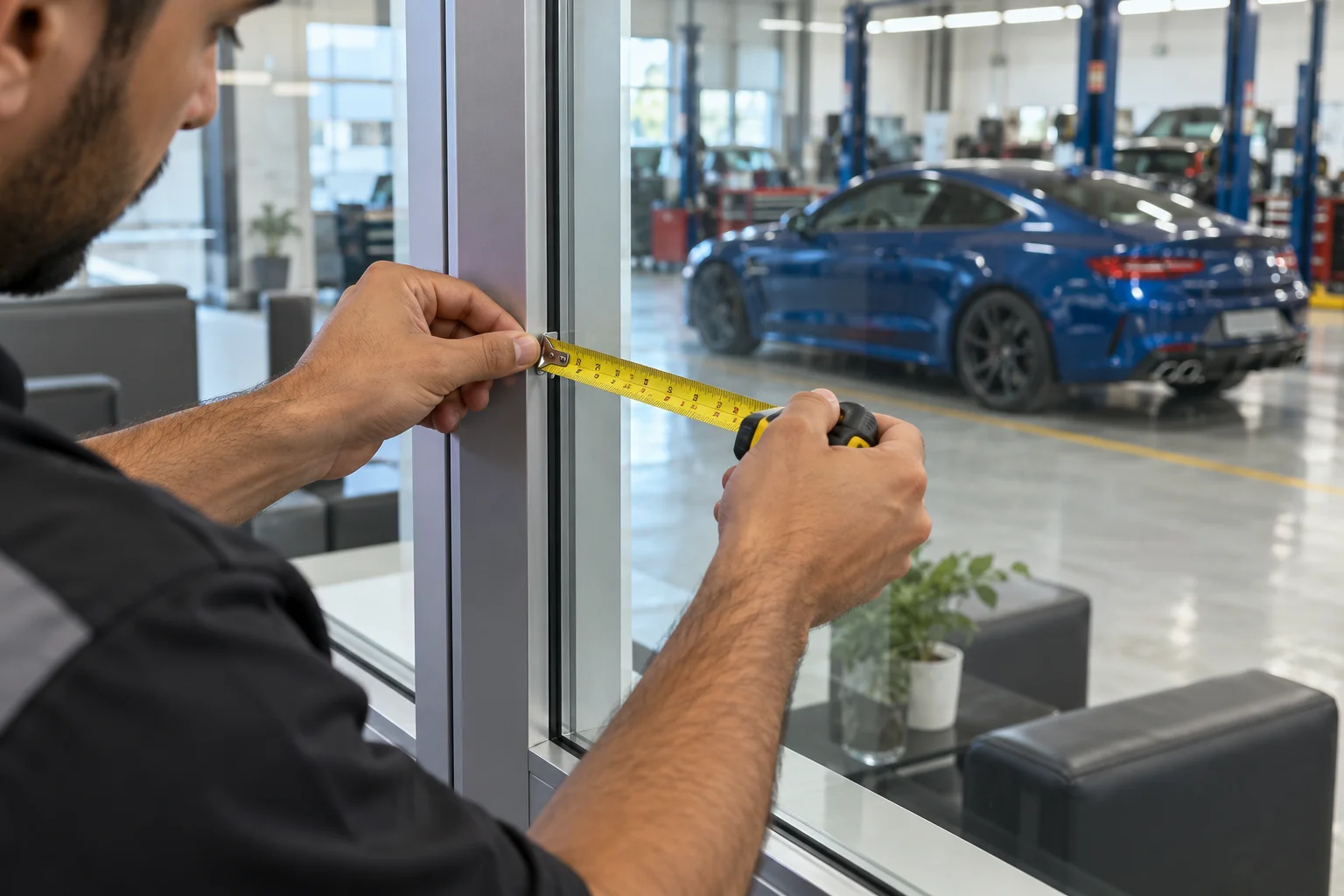
Technician measures an aluminium partition frame beside a blue coupe in a garage
Pane sizes and frame details help plan the film edges and concealed cable route.
Before materials are ordered

Check the glass, the edges and the power route

The survey should identify the glazing construction, coatings, condition and exposure. Indoor partitions, exterior windows and moisture-prone locations do not automatically accept the same film.

Show the full pane, frame and nearby fittings. Confirm available edge space, whether the panel moves and whether a cable can be routed without being pinched, pulled or exposed to damage.

Existing film may need removal. Cracked glass, damaged seals or loose frames need their own assessment. A switchable film installation is not a repair for defective glazing.

Size and shape

Maximum sheet dimensions, holes, cut-outs and joints depend on the manufacturer. Agree panel divisions and visible seams before custom material is made.

Environment

Confirm temperature, sunlight, humidity and cleaning exposure against the product rating. A sample that works indoors does not prove suitability for an exposed installation.

Maintenance access

Locate controllers and serviceable connections where they can be reached later. An inaccessible power supply can turn a small fault into disruptive remedial work.

An electrical system, not just a film

Agree the power supply and controls before fitting

01

Use a matched supply

The operating voltage, waveform and load depend on the selected product. Do not assume film connects directly to mains electricity or a vehicle battery. Ask for the specified power supply and a connection plan from the responsible installer.

02

Size the controller for the panels

Confirm the total connected area and which panels operate as a group. Controller capacity, cable arrangement and manufacturer limits should be checked before adding more panels to an existing system.

03

Check control compatibility

Not every film supports variable dimming, smart-home integration or every remote control. A lighting dimmer is not an automatic substitute for a compatible film controller. Specify the control you want before approving the order.

04

Ask about running power

Request the product’s rated consumption and operating assumptions. For systems requiring power to remain clear, intended daily operating hours affect usage. Do not infer consumption from an unrelated brand’s brochure or a generic claim of low energy use.

Considering it for a car?

Check switchable film suitability for your vehicle

Start with the exact window. A fixed partition, moving side window, roof panel and windscreen require different checks.

01

Can you see clearly in every required state?

Assess haze, reflections, transmitted light and the power-loss state. A frosted state can obstruct the view rather than behaving like ordinary dark automotive film.

02

Can the glass and wiring work together?

Review window travel, seals, curvature, repeated flexing and cable protection. Do not assume an opening window will continue to operate normally after a generic retrofit.

03

Is the complete system suitable for this vehicle?

Power integration, sensors, demisting features and electrical protection need assessment. Ask for evidence covering the proposed product and installation, not only an architectural film specification.

Confirm approval before purchase

A switchable-panel demonstration does not establish road-use approval in Dubai. Confirm applicable requirements with the relevant vehicle authority and keep the product evidence and installation records. Switching the film clear does not replace these checks. Do not fit a system that can obstruct a required driving view when power fails. A building partition, private display project and road vehicle are separate applications, and none confirms suitability for the others. RTA’s vehicle inspection service describes roadworthiness inspection. It does not approve a switchable product or installation.

For everyday solar control without a powered system, compare ceramic car tinting.

From enquiry to handover

Your switchable film installation, step by step

Approve the product and appearance first. Then agree the dimensions, electrical work and fitting arrangements before materials are ordered.

Before work begins

Confirm the panes included, controller location, cable finish, access requirements and who signs off the electrical work.

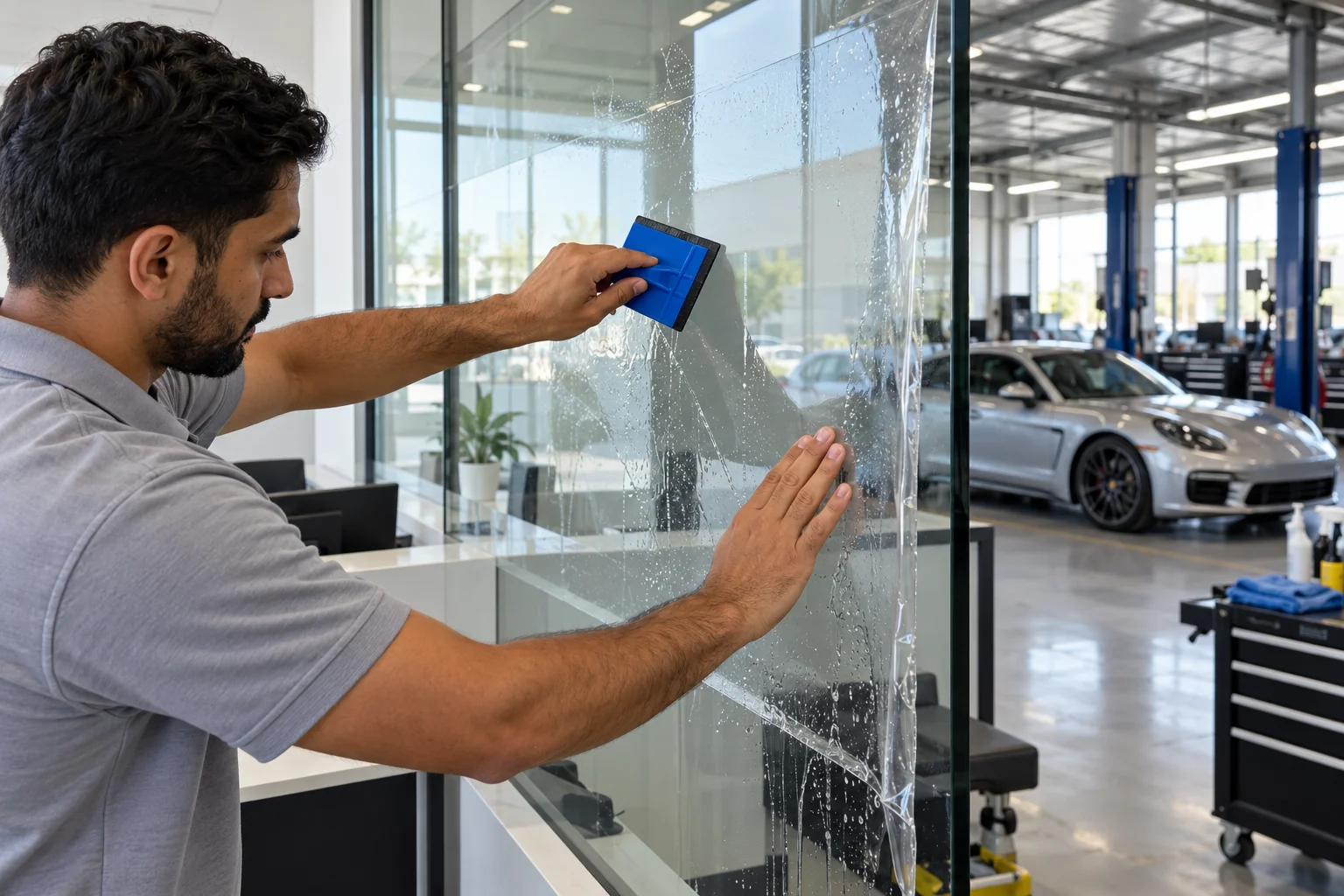
Installer works on a garage reception glass panel with a silver car in the background
Application context. The chosen switchable product determines its fitting method.
  1. 01 / Select

    Confirm the product and sample

    Agree the application, privacy requirement, appearance and control method. Confirm availability before treating a generic product name as an order.

    Review both states, viewing angles and lighting. Record accepted haze, visible borders or seams before custom manufacture.

  2. 02 / Install

    Fit the agreed system

    Approve the pane schedule, power arrangement, edge protection and exclusions. Confirm who supplies power and makes good surrounding finishes.

    Follow the product instructions. Some adhesive switchable films require dry installation. Do not assume a wet automotive-tint method is suitable, or that powered film needs no adhesive.

  3. 03 / Handover

    Test, demonstrate and document

    Check every panel, control group and power-loss response. Demonstrate normal operation to the people who will use the system.

    Obtain component details, care instructions, warranty terms and the fault-reporting route. Keep the final control instructions with the facilities or reception team.

Plan around your premises

Agree access and timing

Custom material, sample approval, building permissions and controller availability can affect the programme. A small pane count does not establish same-day completion.

For an occupied office or showroom, agree the areas to clear, whether fitting needs to be phased and who can approve changes. Confirm any curing or finishing restrictions before staff use the room again.

Tools and techniques

Preparation and electrical finishing both matter

Measurement and clean handling

Accurate dimensions, approved drawings and clean working conditions help avoid sizing errors and trapped contamination. Handle sheets without folding or creasing them and follow the manufacturer’s rules for cutting and contacts.

Product-compatible application

Use the preparation materials, application tools and sealing products specified for the selected system. A familiar tinting solution or sealant should not be substituted without checking compatibility.

Electrical checks and labelling

The responsible electrical installer should verify the specified supply and connections, then label the controller and switching groups. Keep records so a later repair can identify the actual components.

Installation reference Smart Film installation guidance. Its dry-application instructions apply to the described product, not every smart-film system.

Avoid the wrong solution

Common concerns and what to check

Checks before approving a switchable installation
ConcernUseful next step
The clear state looks cloudyCompare the actual sample, viewing angle and lighting with the agreed specification. Some haze is inherent to the product.
Silhouettes remain visibleTest distance and backlighting. Decide whether the required privacy calls for a different material or additional screening.
You want darkness as well as privacySpecify light blocking separately. Conventional frosted PDLC is not a blackout solution.
A panel stops switchingContact the installer with the panel and controller details. Do not open electrical components or alter connections yourself.
An edge is lifting or damagedArrange a review before cleaning around it or attempting a repair. Protect the area from moisture as directed by the installer.

For fixed privacy without power or controllers, explore commercial frosted film. It serves a different need and does not switch clear.

After fitting

Aftercare and support for your switchable system

Give cleaners and facilities staff the right instructions. Keep the component records ready if the system needs attention.

Everyday cleaning

Protect the surface and edges

Follow the supplied waiting periods and use compatible cleaning products. Avoid saturating exposed edges, scraping the surface or disturbing electrical contacts and protective finishes.

Building maintenance

Keep controls accessible

Make sure cleaners know which side carries the film. A decorator should not remove an edge cover or conceal a controller without understanding its function. Keep serviceable connections accessible.

If something changes

Report the panel and the symptom

Tell the installer which pane is affected, what the controls do and when the issue started. Share clear photographs where useful. Do not open electrical components or alter connections yourself.

Choose evidence that matches the work

Request a product data sheet and permission-cleared examples of comparable completed work where available. The garage images here show application contexts, not verified switchable installations or measured optical results.

Questions before you enquire

Electric tint and switchable film FAQs

What electric tint do you currently offer?

Product availability is confirmed for each enquiry. Ask for the manufacturer, model, technology and intended application before approving a quotation. PDLC, SPD and electrochromic products should not be treated as interchangeable options or assumed to be in stock.

Does switchable privacy film become completely clear?

The powered state can still show haze, reflections or a colour cast. Check the actual sample under your lighting and from the angles that matter to you. Clear-state appearance is a product-specific characteristic, not a guarantee of an invisible film.

What happens when the power fails?

Conventional normally opaque PDLC becomes frosted when its supply is removed. Other products can behave differently. Confirm the exact fail state and the effect on visibility, privacy and access before ordering.

Will it make my room completely dark?

Standard PDLC privacy film scatters transmitted light and is not a blackout product. A private-looking panel can still admit substantial daylight. If darkness is essential, specify that requirement separately and assess a product designed for it.

Is electric tint approved for road use in Dubai?

This page does not establish approval for a vehicle or window. Request product-specific automotive suitability and confirm applicable requirements with the relevant vehicle authority before purchase. The ability to switch clear is not proof of road-use suitability.

Can it be fitted to opening car windows?

Do not assume an architectural retrofit film is suitable for moving vehicle glass. Window seals, repeated movement, curvature, wire routing, temperature and visibility all need product-specific review. Confirm the exact window and system before any fitting is proposed.

How much does a switchable film installation cost?

A written quote needs the pane dimensions, product, controller, wiring route, access and preparation requirements. Ask for the film-area unit and separate electrical or finishing charges. No fixed vehicle package or current per-square-metre rate is confirmed on this page.

Can I use a normal dimmer switch?

Only use controls approved for the selected film and power supply. A standard lighting dimmer may not be compatible. Agree the switch, remote or integration requirements before ordering the controller.

Start with your project

Find out whether switchable film suits your glass

Send your glass photos, approximate sizes and the result you want. For a vehicle, include its make, model, year and exact window position. The team will confirm what can be considered before preparing a quotation.